Showing posts with label climate change. Show all posts

Thursday, November 21, 2013

For a Left Strategy on Climate Change

The Editors
November 2013

There is a pressing need for a coherent left strategy on climate change and in relation to the planetary environmental threat in general. The current scientific consensus indicates that we have at best several decades before the earth’s average surface temperature rises by 2°C, viewed as the point of irreversible climate change. This means that decisive action must be taken quickly if the world is not to go off the planetary climate cliff.

We therefore read with considerable interest Christian Parenti’s article, “A Radical Approach to the Climate Crisis” in the Summer 2013 issue of Dissent. Parenti’s main thesis is that since the time with which to address the climate change problem is so short, “it is this society and these [existing capitalist] institutions that must cut emissions. That means, in the short-term, realistic climate politics are reformist politics, even if they are conceived of as part of a longer-term anti-capitalist project of total economic re-organization.”

Tuesday, November 12, 2013

Capitalism and the destruction of life on earth: Six theses on saving the humans

By Richard Smith
Real World Economics Review, Issue 64, July, 2013

‘Today, the world’s richest 1% own 40 percent of the world’s wealth. Tell me again where Karl Marx was wrong?’


When, on May 10, 2013, scientists at Mauna Loa Observatory on the big island of Hawaii announced that global CO2 emissions had crossed a threshold at 400 parts per million for the first time in millions of years, a sense of dread spread around the world – not only among climate scientists.

CO2 emissions have been relentlessly climbing since Charles David Keeling first set up his tracking station near the summit of Mauna Loa Observatory in 1958 to monitor average daily global CO2 levels. At that time, CO2 concentrations registered 315ppm. CO2 emissions and atmospheric concentrations have been climbing ever since and, as the records show, temperatures rises will follow. For all the climate summits, the promises of “voluntary restraint,” the carbon trading and carbon taxes, the growth of CO2 emissions and atmospheric concentrations has not just been relentless, it has been accelerating in what scientists have dubbed the “Keeling Curve.”

Read more HERE.

Saturday, March 30, 2013

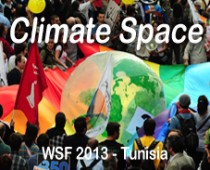
The fight against climate change takes its space in the World Social Forum

PRESSE-TOI À GAUCHE
MARCH 30, 2013

Fight for the environment can be costly. There have been many murders and disappearances of activists environmentalists. Sombath Somphone, Laos is one of those victims. Pablo Solón, director of Focus on the Global South, stated yesterday during the inauguration of the "Space Climate" World Social Forum (WSF) taking place currently in Tunis.

For the first time, a WSF account with a specific and permanent space to analyze the causes and impacts of climate change, to exchange experiences and discuss new strategies to confront the ecological crisis. This is the "Space Climate", supported by nearly 40 environmental organizations around the world, such as La Via Campesina, Focus on the Global South, the ETC Group, Ecologists in Action, or ATTAC France, among other.

Climate change is a central element in the systemic crisis of capitalism, it threatens the future of life on the planet and clearly highlights the inability of the current model to solve really. Climate change, governments, international institutions and multinational coincide fully depress the accelerator and bet on a series of false technological solutions, instead of solving the crisis, will instead deepen even more. They also promote market solutions to fill their pockets with the purchase and sale of greenhouse gas emissions. Nature becomes a commodity and more a source of profit masked by green rhetoric without real content. A green that looks like the dollar and not that of nature.

The organizers of the "Space Climate" do not go around the bush because time is against us and the world: "We have lost too many important battles in the fight for climate justice and we have little time to prevent Mother Earth and humanity rushing into the abyss. Climate change is already causing 400,000 deaths per year. ". But they also highlight the need for hope and mobilization by stating that "we need to act if we want to change the future."

We now see how the economic crisis further exacerbates the climate crisis, energy and food. The same people who speculated with mortgages "subprime" venture funds, insurance companies, etc.., Are those today who monopolize land and speculating with food. Everything is good for profit: water, seeds, land, grain. As stated Nnimmo Bassey of Oil Watch International at the end of the inauguration of the Espace Climate: "It is time to intensify the struggle and create alliances."This is also the commitment ratified by numerous assistants. As the song says: "The people united will never be defeated! ".

Tunis 28/03/2013.

Source: http://blogs.publico.es/esther-viva ...

Wednesday, February 13, 2013

James Hansen and the Climate-Change Exit Strategy

By John Bellamy Foster
Monthly Review
February, 2013

Humanity is not a bunch of lemmings marching unstoppably toward a cliff. There is such a thing as free will…. People please wake up! For the sake of young people, future generations, and other life on our planet, don’t settle for what some “experts” say is the best we can do.
— James Hansen

The Climate Cliff

The world at present is fast approaching a climate cliff. Science tells us that an increase in global average temperature of 2°C (3.6° F) constitutes the planetary tipping point with respect to climate change, leading to irreversible changes beyond human control. A 2°C rise is sufficient to melt a significant portion of the world’s ice due to feedbacks that will hasten the melting. It will thus set the course to an ice-free world. Sea level will rise. Numerous islands will be threatened along with coastal regions throughout the globe. Extreme weather events (droughts, storms, floods) will be far more common. The paleoclimatic record shows that an increase in global average temperature of several degrees means that 50 percent or more of all species—plants and animals—will be driven to extinction. Global food crops will be negatively affected. For example, a 2011 report of the National Resource Council indicates that the U.S. corn (maize) crop, which accounts for 40 percent of the world’s total, will experience a 25 percent decline in average yield with a 2°C rise in temperature.

Read more HERE.

Saturday, December 22, 2012

China’s Capitalism and the Climate

By Robert Hunziker
Dissident Voice
December 22nd, 2012


China’s three-decade-old conversion to state capitalism has radically transformed the country. As a result, more than one-half of China’s population now lives in an urban setting versus 26% in 1990, and China has 19 mega cities each with over 10 million population. This vast undertaking has become a way forward for a population of 1.4 billion people (a population larger than the United States, the European Union, and South America combined) to conduct business on the world stage, and the ramifications are felt all across the planet.

As China increasingly adapts to capitalism, conflict arises within its own society as well as beyond its borders. Capitalism’s penchant for conflict goes back as far as the middle of the 19th century when Karl Marx was the first economist in the world to notice how “boom & bust” economic cycles were largely unknown to the world until capitalism hit the scene. These boom & bust cycles may be unique to capitalism, but China, outside of the past three decades, for a thousand years was quiet, pastoral, and self-sufficient, ignoring the outside world. However, nowadays China has come face-to-face with the world like a fire-eating dragon.

Monday, September 24, 2012

Trade unions must join the fight against climate change

By Ian Angus
ESSF website
29 September 2011

Ian Angus, editor of Climate and Capitalism, is currently in Australia to speak at the Climate Change Social Change conference in Melbourne, September 30 – October 3.

During his pre-conference speaking tour, he was invited to address several meetings of trades union members. The following is a lightly edited transcript of the opening comments he made at union meetings in Melbourne and Geelong.


“If we leave this issue to the bosses, to the corporations and politicians who profit from the existing system, the changes will be inadequate – and they will put the entire burden on working people.”

Thank you for inviting me to speak today.

This week, in Canada, hundreds of people gathered on Parliament Hill, in Ottawa, to support a civil disobedience action against the environmental crime known as the Alberta Tar Sands, and the related Keystone XL pipeline.

Thursday, August 16, 2012

Weapons for the Weak in the Climate Struggle

By Walden Bello
Foreign Policy in Focus
August 16, 2012


This past month was the hottest July in the United States ever recorded. In India, the monsoon rains are long delayed, resulting in the country’s second drought in four years. Triple-digit temperatures in New Delhi and other cities have already provoked the worst power outages in the country’s history and the expected bad harvest is likely to slice at least 5 percent from GDP growth.

In Beijing, which usually suffers from a shortage of water, a storm on July 21 resulted in the worst flooding since recordkeeping began in 1951, according to theEconomist. Meanwhile, here in the Philippines, a protracted, weeklong rainstorm plunged Metropolitan Manila into a watery disaster that is probably the worst in recent history.

If there is any doubt that the abnormal is now the norm, remember that this is shaping up to be the second straight year that nonstop rains have wreaked havoc in Southeast Asia. Last year, the monsoon season brought about the worst flooding in Thailand’s history, with waters engulfing Bangkok and affecting over 14 million people, damaging nearly 7,000 square miles of agricultural land, disrupting global supply chains, and bringing about what the World Bank estimated to be the world’s fourth costliest disaster ever.

Friday, August 10, 2012

Creative accounting, not climate progress behind Kent's 'progress' report


BY  CHRISTIAN HOLZ
Rabble.ca
August 9, 2012

During the press conference that accompanied yesterday’s launch of the 2012 edition of Environment Canada’s “Canada’s Emissions Trends”, Environment Minister Peter Kent claimed the report shows that Canada is now “half way to its target of reducing total greenhouse gas emissions by 17 percent from 2005 levels by 2020.” While Kent went on to claim credit for this purported progress on behalf of the Harper government’s sector-by-sector regulatory approach to greenhouse gas pollution, for most observers it seemed to good too be true, given that the previous year’s installment of the same report indicated that the country had only gone a quarter of its way to that target.

Indeed, a closer read of the report reveals that it is changes in carbon accounting practices rather than actual changes in the federal government’s climate policy that explain most of the difference between this year’s and last year’s numbers. Lower emission numbers on paper are not matched by lower emissions to the atmosphere or any improvements within federal climate policies. In fact, about two thirds of the “progress” claimed by Kent on behalf of his government can be attributed to these changes in accounting. What’s more, more than half of the amount resulting from these dodgy figures would probably trigger an investigation into fraudulent accounting practices, at least in the world of financial accounting.

Tuesday, April 10, 2012

Earth on Edge: International Scientific Community Issues First “State Of The Planet Declaration”

By Owen Gaffney
EurekAlert
April 10th 2012

Scientists issued the first "State of the Planet" declaration at a major gathering of experts on global environmental and social issues in advance of the major UN Summit Rio+20 in June.

The declaration opens: "Research now demonstrates that the continued functioning of the Earth system as it has supported the well-being of human civilization in recent centuries is at risk." It states that consensus is growing that we have driven the planet into a new epoch, the Anthropocene, where many planetary-scale processes are dominated by human activities. It concludes society must not delay taking urgent and large-scale action.

Sunday, March 18, 2012

The Crisis of Civilization

The Crisis of Civilization video

The Crisis of Civilization is a documentary feature film investigating how global crises like ecological disaster, financial meltdown, dwindling oil reserves, terrorism and food shortages are converging symptoms of a single, failed global system.

Weaving together archival film footage and animations, film-maker Dean Puckett, animator Lucca Benney and international security analyst Dr. Nafeez Mosaddeq Ahmed – author of A User’s Guide to the Crisis of Civilization: And How to Save It – offer a stunning wake-up call proving that ‘another world’ is not merely possible, but on its way.

Like the book on which it is based, the film consists of seven parts which explore the interconnected dynamic of global crises of Climate Catastrophe; Peak Energy; Peak Food; Economic Instability; International Terrorism; and the Militarization Tendency – with a final section on The Post-Peak World.

The film reveals how a failure to understand the systemic context of these crises, linked to neoliberal ideology, has generated a tendency to deal not with their root structural causes, but only with their symptoms. This has led to the proliferation of war, terror, and state-terror, including encroachment on civil liberties, while accelerating global crises rather than solving them.

The real solution, Nafeez argues, is to recognise the inevitability of civilizational change, and to work toward a fundamental systemic transformation based on more participatory forms of living, politically, economically and culturally.

Also featuring clowns, car crashes, explosions, acrobats, super heroes, xylophones and much, much more!

FULL VIDEO BELOW...

Sunday, March 4, 2012

Warming of two degrees inevitable over Canada: study

PhysOrg.com
March 4, 2012

SFU geographer Kirsten Zickfeld notes in a new paper she has co-authored that northern hemisphere dwellers will suffer more severe effects of climate change than others.

Even if zero emissions of greenhouse gases were to be achieved, the world’s temperature would continue to rise by about a quarter of a degree over a decade. That’s a best-case scenario, according to a paper co-written by a Simon Fraser University researcher.

“Let’s be honest, it’s totally unrealistic to believe that we can stop all emissions now,” says Kirsten Zickfeld, an assistant professor of geography at SFU. “Even with aggressive greenhouse gas mitigation, it will be a challenge to keep the projected global rise in temperature under 2 degrees Celsius,” emphasizes Zickfeld.

Sunday, February 19, 2012

On the environment Canada is a rogue state

From Murray Dobbin's Blog 
February 19, 2012

There are so many areas of conventional democratic governance being challenged or eliminated by the Harper wrecking crew it is hard to keep up. In a search for a line in the sand that even this government won’t cross we still haven’t found it. So far, it seems, there is nothing in the broad field of democratic governance (save the military and prisons) that is sacrosanct.

Minimally, all governments take seriously the protection of their citizens; otherwise there is scarcely any point in having one. Yet recent reports reveal that that the Harper government has virtually eliminated monitoring of the ozone layer over Canada. The government has shut down four of five very sophisticated monitoring stations leaving only a single station – at UBC in Vancouver – still gathering information about this critical aspect of our environment.

Thursday, January 12, 2012

Fighting for a Real Green Economy

By Anil Naidoo
Council of Canadians
January 12th, 2012

Dear Friends,

The Zero Draft document was released this week and this will be the starting point for negotiations at the Rio+20 Earth Summit. It is a very general document and seems to be fairly non-threatening, but please do not be fooled!

If you have been following Rio+20, you will know that the Green Economy is being heavily promoted for Rio. We understand that our current actions are unsustainable and so most of us would welcome a Green Economy, but as Maude Barlow and Pablo Solon have articulated in the book “The Rights of Nature: The Case for a Universal Declaration of the Rights of Mother Earth”, this proposed Green Economy is very dangerous. Passages from both are attached below….

Leaked Rio+20 document outlines 10 sustainable development goals

By Brent Patterson
Council of Canadians
January 10th, 2012

The Guardian reports, “Countries will be asked this summer to sign up for 10 new sustainable development goals for the planet and promise to build green economies… According to a leak of the draft agenda document seen by the Guardian, they will also be asked to negotiate a new agreement to protect oceans, approve an annual state of the planet report, set up a major world agency for the environment, and appoint a global ‘ombudsperson’, or high commissioner, for future generations.”

“Governments will (also) be expected to strengthen the Nairobi-based UN Environment Programme body which is widely thought to be underfunded and unable to address the growing threats to ecosystems. UNEP is likely to be put on the same level as the World Health organisation (WHO) and the Food and Agriculture Organisation (FAO). …(And) although the agenda could change in the next six months, it looks likely they will be asked to pledge to use stretched resources better and reform the subsidy system of fossil fuels which encourages climate change.”

Call for building and mobilizing for Peoples Assembly at Rio+20

Climate Connections
January 11, 2012


We call organizations, Networks and movements in the struggle for Environmental Justice, against the greening of capitalism and mercantilization of life and in defence of common goods, to join this call and the process of building and mobilizing for the Peoples Assembly at the Peoples Summit during Rio+20, between 15 and 23 June 2012 in Rio de Janeiro.

An assembly of peoples affected, oppressed and aware of the structural causes of systemic crisis and related social and environmental injustices; of peoples affected, indignant, critical and resistant to the new forms of reproduction, militarization and greening of capitalism; of peoples that mobilize and transform, protect traditional knowledge, create and recreate real solutions and no capitalist alternatives, defend the common goods and claim for the Right of Mother Earth.
-----
To join this call, send an email with the name of the organization and country until 21/01/2012 to: movilizacion.rio20@gmail.com
-----
Continental Cry of the Excluded, Convergence of Movements of the Peoples of the Americas, Coordinator of Andean Indigenous Organizations, Friends of the Earth Latin America and the Caribbean, Grassroots Global Justice, Jubilee South/Americas, Oilwatch, Southern People’s Ecological Debt Creditors Alliance, La Vía Campesina, World March of Women, World Rainforest Movement

Wednesday, January 4, 2012

The Biggest Story of 2011 for Me? Canada’s Failure on Climate Change

By Maude Barlow
Council of Canadians
December 26th, 2011

The biggest story of 2011 for me was the national and international attention given to the environmental dangers of Canada’s tar sands, and the failure of the Harper government to meet our obligations to combat climate change. Until this year, most criticism of Canada’s climate policy was restricted to Canadian and some international environmentalists. But three events of 2011 caused Canada’s energy and climate policies to come under intense scrutiny here in Canada and around the world.

The first was the surprisingly passionate and bitter debate in the U.S. over the Keystone Pipeline, meant to carry Alberta bitumen - the dirtiest oil on earth - over an endangered aquifer to be refined in Texas. A noisy and organized opposition that included environmentalists, Native Americans, ranchers, and even Republican politicians sounded the alarm. They made daily national and international news in the late summer when over 1,200 people got arrested in front of the White House. That inspired a more active movement in Canada. 

Thursday, December 29, 2011

Quebec on the verge of catastrophic climate change, expert says

By William Marsden
The Gazette
December 29, 2011

Richelieu River Flooding

Record floods, melting permafrost, shoreline erosion and intense winds caused havoc for thousands of Quebecers as 2011 proved to be yet another year of higher than normal temperatures.

These higher temperatures add to the credibility of climate models that have predicted the march of global warming will accelerate the more greenhouse gases we pump into the atmosphere, scientists say.

“It is striking that over the last 10 to 15 years we didn’t have a single season colder than normal,” said Alain Bourque, director of climate change impacts and adaptation at Quebec’s climate change research institute Ouranos. “That is a clear indication that Canada’s climate is heating up beyond any reasonable doubt.”

The true colors of green economy

By Silvia Ribeiro
América Latina en Movimiento
December 19, 2011

Twenty years after the UN Conference on Environment and Development (World Summit or Eco ‘92) a new world conference will take place in Rio de Janeiro, Brazil, in June 2012. Rio+20, as it is known, will be set in the midst of the greatest global crises in the century: environmental devastation, biodiversity erosion, climate crisis, economic and financial crisis, food crisis, and health crisis.

Although Rio+20 was supposed to review the commitments made, the state of the real problems and the strategies to resolve them, the issues on the agenda are green economy and new forms of global environmental governance. If the term “sustainable development” was ambiguous and was profusely manipulated, the substitution for green economy points to an even more restrictive approach, which privileges those who dominate the markets.

Tuesday, December 27, 2011

Corporations, climate and the United Nations: How big business has seized control of global climate negotiations

Polaris Institute
December 2011

In time for COP 17 in Durban, South Africa, the Polaris Institute  prepared a report outlining how multinational corporations and their lobbyists have infiltrated the United Nations and are influencing the outcomes of climate negotiations. The report uncovers and describes where corporations influence the United Nations in the build up to and during climate change negotiations and how this corporate interest is the driving force behind the preferred market based initiatives that are emerging from the UNFCCC process.

Examples of corporate infiltration of the UNFCCC process are presented in order to highlight how multilateral and national level climate change policies carry the fingerprints of corporate interests. The corporate control of agendas inside the UN is not new and the report is framed within the historical roots of the access business and industry enjoy inside the United Nations.

This report exposes and critiques the corporate powers that influence the UNFCCC and use the United Nations to mask damaging operations. In conclusion, the report calls on activists to bring these corporate powers to account along with a UN system that has spent far too long working in partnership with destructive corporations instead of regulating their troublesome behaviour.

For the full report, go to http://www.polarisinstitute.org/files/CorporationsClimateandtheUN.pdf