Saturday, April 6, 2013

Unity Statement on Ecological Justice

By FRSO/OSCL 
Tuesday February 5th, 2013


The following unity statement on Ecological Justice — the first new unity statement for FRSO/OSCL since 1991 — was adopted at our January 2013 Congress. With a strong focus on ecology and the necessity of left analysis and practice that centers and emphasizes ecology, the statement is the outcome of the last three years of summation, study, and practice, as well as countless years of experience in environmental justice and ecological work by a number of our members.

In 2010 we embarked on a multi-part national study of ecological crises, social movements that center ecology, indigenous struggles, eco-socialism, eco-feminism and much more. We engaged our membership around key ideas, questions and contradictions facing the left and humanity in relationship to ecological crises as they intersect with economic and political crises in the 21st century. We also prioritized, as an organization, sending members and leaders to retreats hosted by the Movement Generation Justice and Ecology Project.

Out of the national study and the work of the Ecology Workteam of FRSO/OSCL, we drafted a statement, looking towards the adoption of a unity statement at our 2013 Congress. We had four major re-writes of the statement, countless discussions, debate, regional workshops and political education sessions with members in order to reach a place of agreement and unity as members of FRSO/OSCL.

Structural adjustment or…. Ecosocialism

By Victor Quintana
REVOLTINGEUROPE 
APRIL 7, 2013

Like medieval plagues, structural adjustment programmes implemented through southern Europe economies are destroying families, trampling on social rights, eliminating jobs, and making life precarious. Burying the hopes of the populations are the political parties that rotate in equal doses in one failed government after another. Given the right-wing and social democratic alternance it seems that all voters in Southern Europe are deciding is how, and at what speed their social rights are to be liquidated.

In this situation, the Left, called by many, the radical left, are adopting a new alternative to meet the challenge of these times that threaten social life, the integrity of the people, the environment, the community of living beings: Ecosocialism. It was presented at the National Congress of the Parti de Gauche (Left Party) held in Bordeaux, France from 22 to 24 March. This party formed the Left Front with the French Communist Party and other smaller parties, in 2012, with Jean Luc Melenchon as presidential candidate and achieved a historic 11% of the votes in the first round.

Trade Unions in the Green Economy: Working for the Environment

BY DOUGLAS COKER
COUNTERFIRE 
06 APRIL 2013

Need there be a conflict between jobs and climate change? The positions of trade unions internationally on problems of climate change and the environment is explored in a varied collection of articles, reviewed by Douglas Coker.

Trade Unions in the Green Economy: Working for the Environment, eds. Nora Rathzel and David Uzzell, foreword by Tim Jackson (Routledge: Earthscan, 2013), xiv, 238pp.

The threats from global warming and climate change are well established. Progress on implementing measures to mitigate global warming have been woefully inadequate and currently seem to have stalled completely. Governments at all levels have disappointed, business responses vary with much greenwash evident, so what, one might wonder, have trade unions been doing in response to the threat from global warming? This much needed book, Trade Unions in the Green Economy: Working for the Environment, provides some answers.

Edited by Nora Rathzel and David Uzzell with a foreword by Tim Jackson, author of Prosperity Without Growth, a wide range of authors contribute eighteen chapters in total. Academics dominate, senior staff from UN and trade union organisations contribute, and we have one contribution from a consultant, and last but not least one contribution from a Swedish autoworker (one of Gramsci's ‘organic intellectuals’?).

Tuesday, April 2, 2013

Imperial recipes for a burnt planet

Socialist Worker
April 2, 2013

Chris Williams, author of Ecology and Socialism: Solutions to Capitalist Ecological Crisis, explains the critical connection between imperialism and ecological destruction.


AT THE turn of the 19th century, industrialist and weapons manufacturer par excellence Alfred Nobel, the guilt-ridden inventor of dynamite, established the Peace Prize that carries his name, proposing that it go "to the person who shall have done the most or the best work for fraternity between the nations, for the abolition or reduction of standing armies, and for the holding and promotion of peace congresses."

Over 100 years later, for the first time ever, a Nobel Peace Prize was awarded to an African woman. The 2004 award was controversial. Politicians from the country responsible for the awards, Norway, wanted to know what this woman from Kenya had done for peace.

Carl I. Hagen, leader of Norway's Progress Party, whose senior political adviser, Inger-Marie Ytterhorn, was a member of the Nobel Committee, sneeringly dismissed giving the Prize to a mere environmental activist: "I thought the intention of Alfred Nobel's will was to focus on a person or organization who had worked actively for peace...It is odd that the committee has completely overlooked the unrest that the world is living with daily, and given the prize to an environmental activist."

Monday, April 1, 2013

The Tar Sands Disaster

BY THOMAS HOMER-DIXON
New York Times
March 31, 2013


IF President Obama blocks the Keystone XL pipeline once and for all, he’ll do Canada a favor.

Canada’s tar sands formations, landlocked in northern Alberta, are a giant reserve of carbon-saturated energy — a mixture of sand, clay and a viscous low-grade petroleum called bitumen. Pipelines are the best way to get this resource to market, but existing pipelines to the United States are almost full. So tar sands companies, and the Alberta and Canadian governments, are desperately searching for export routes via new pipelines.

Canadians don’t universally support construction of the pipeline. A poll by Nanos Research in February 2012 found that nearly 42 percent of Canadians were opposed. Many of us, in fact, want to see the tar sands industry wound down and eventually stopped, even though it pumps tens of billions of dollars annually into our economy.

Saturday, March 30, 2013

BRICS cook the climate

By Patrick Bond
Pambazuka News
2013-03-27, Issue 623


The BRICS are surpassing the US and the EU in terms of emissions of greenhouse gases. The Durban summit was an opportune moment to ask and answer many questions regarding the BRICS’ economic strategies and to radically reduce their levels of emissions.

As they met in Durban on March 26-27, leaders of the BRICS countries – Brazil, Russia, India, China and South Africa – must own up: they have been emitting prolific levels of greenhouse gases, far higher than the US or the EU in absolute terms and as a ratio of GDP (though less per person). How they address this crisis could make the difference between life and death for hundreds of millions of people this century.

South Africa’s example is not encouraging. First, the Pretoria national government and its Eskom parastatal electricity generator have recently increased South Africa’s already extremely high emissions levels, on behalf of the country’s ‘Minerals-Energy Complex’. This problem is well known in part because of the failed civil society campaigns against the world’s third and fourth largest coal-fired power plants (Eskom’s Medupi and Kusile), whose financing in 2010 included the largest-ever World Bank project loan and whose subcontractor includes the ruling party’s investment arm in a blatant multi-billion rand conflict of interest.

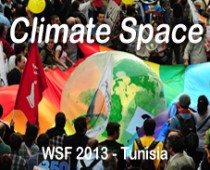
The fight against climate change takes its space in the World Social Forum

PRESSE-TOI À GAUCHE
MARCH 30, 2013

Fight for the environment can be costly. There have been many murders and disappearances of activists environmentalists. Sombath Somphone, Laos is one of those victims. Pablo Solón, director of Focus on the Global South, stated yesterday during the inauguration of the "Space Climate" World Social Forum (WSF) taking place currently in Tunis.

For the first time, a WSF account with a specific and permanent space to analyze the causes and impacts of climate change, to exchange experiences and discuss new strategies to confront the ecological crisis. This is the "Space Climate", supported by nearly 40 environmental organizations around the world, such as La Via Campesina, Focus on the Global South, the ETC Group, Ecologists in Action, or ATTAC France, among other.

Climate change is a central element in the systemic crisis of capitalism, it threatens the future of life on the planet and clearly highlights the inability of the current model to solve really. Climate change, governments, international institutions and multinational coincide fully depress the accelerator and bet on a series of false technological solutions, instead of solving the crisis, will instead deepen even more. They also promote market solutions to fill their pockets with the purchase and sale of greenhouse gas emissions. Nature becomes a commodity and more a source of profit masked by green rhetoric without real content. A green that looks like the dollar and not that of nature.

The organizers of the "Space Climate" do not go around the bush because time is against us and the world: "We have lost too many important battles in the fight for climate justice and we have little time to prevent Mother Earth and humanity rushing into the abyss. Climate change is already causing 400,000 deaths per year. ". But they also highlight the need for hope and mobilization by stating that "we need to act if we want to change the future."

We now see how the economic crisis further exacerbates the climate crisis, energy and food. The same people who speculated with mortgages "subprime" venture funds, insurance companies, etc.., Are those today who monopolize land and speculating with food. Everything is good for profit: water, seeds, land, grain. As stated Nnimmo Bassey of Oil Watch International at the end of the inauguration of the Espace Climate: "It is time to intensify the struggle and create alliances."This is also the commitment ratified by numerous assistants. As the song says: "The people united will never be defeated! ".

Tunis 28/03/2013.

Source: http://blogs.publico.es/esther-viva ...

Sunday, March 24, 2013

A critique of the ecosocialist manifesto of the Parti de Gauche

By Daniel Tanuro
Sunday 24 March 2013

Click HERE for link
Daniel Tanuro is the author of L’impossible capitalisme vert (“the impossible green capitalism”). In this article, he presents an analysis of the Ecosocialist Manifesto of the French Left Party. Highlighting the real advances contained in this document, but also its limitations, he contributes to the crucial debate on the necessary ecosocialist strategy.

The Ecosocialist Manifesto of the Left Party (PG) is an important document. For the first time in France, a political force with parliamentary representation adopts the concept of ecosocialism to try and combine social and ecological demands, in a perspective of a break with capitalism. The condemnation of productivism is unambiguous.

The fact that the document rejects as socially unjust and environmentally criminal the social democratic strategy of relaunching the system (Thesis 6: "We therefore expect neither the resumption of growth nor the beneficial effects of austerity: we believe in neither the one or the other") demonstrates an awareness of the seriousness of the situation and the urgency of the measures that must be taken to confront it. That is to say that the manifesto contributes to a fundamental political debate: what alternative to co-management of capitalism by the Greens and social-liberalism? What programme, what vision of society, what strategy for an anti-productivist socialism?

Read more HERE.

Friday, March 22, 2013

The Relevance of Marxism Today

An Interview With Michael A. Lebowitz 

By Zhuo Mingliang
MRzine
March 21, 2013

Do you think Marxism is still relevant today? If so, which parts?

I think that Marxism is completely relevant for understanding capitalism now. It's an error to think that capitalism has changed and that therefore we have to change Marxism. Marx grasped the nature of capitalism; and, although capitalism has changed in some of its forms, its essence remains the same. Capitalism is a system based upon the exploitation and deformation of wage laborers for the purpose of profits for those who own the means of production. That has not changed.

Read more HERE.

Tuesday, March 19, 2013

Stop the Expansion

Dirty Oil Sands Watch


Forty years ago, many Canadians were taught in school that the oil would never be extracted from the tar sands because it was too expensive. But that did not stop the oil sands companies from trying. The first open pit mine began in 1967 and produced 30,000 barrels per day and it took 10 years before the second mine started producing in 1978.

Thing look very different today. Today there are now 5 mines in operation with 7 more proposed or under construction. There are 9 insitu sites producing with 38 either proposed or in the exploration phase.

Currently there are 1.7 million barrels per day (mbd) extracted from the tar sands. If all the approved projects are built , there would be 5 mbd extracted. But the companies won’t stop there. They are considering enough projects to bring it to 9mbd.

That is over 270 million one litre pop bottles per day being produced right now with a goal of over 1.5 billion one litre pop bottles per day in the future.

In order to get this oil to market, there are plans to have four more pipelines ship the increase oil production to market. This includes:

Keystone XL
Northern Gateway
Kinder Morgan
Trailbreaker

Prime Minister Stephen Harper has made it a priority to expedite the expansion of the tar sands, including the rapid approval of more mines and pipelines. When the Prime Minister found a few obstacles in his way, such as public opposition and regulatory processes designed to protect the environment, he tried to overcome them by attacking nature and democracy. By limiting public engagement in the review of major projects like pipelines, attacking conservation groups, and gutting environmental legislation, Harper and the Government of Canada is determined to expand the tar sands putting at risk communities, land, air, water, the climate, and democracy. This must be stopped.

Instead of Harper’s petro-state we need to a low carbon economy, creating jobs and economic prosperity based on the development of clean energy. Pessimists say it can’t be done, that it is too expensive, and that we cannot produce enough energy to replace our dependence on oil. But if people were able to extract oil from the tar sands surely we can figure out a way to harness clean energy and protect our land, air, and water.

Saturday, March 16, 2013

Le Reseau ecosocialiste: Toward new ways of organizing

BY NORA LORETO
MARCH 14, 2013


There seems to be a growing consensus on the left that the environment is ground zero for our work. The capacity for capitalism to destroy the earth through mining, fracking, consumption, waste, destruction of watersheds and other natural elements seems to know no reasonable limits.

While activists have long targeted environmental degradation, placing eco-justice at the centre of organizing that isn’t soley focused on the environment has taken some time. With analyses that have emerged that frame environmental destruction in terms of environmental racism, colonialism and neo-colonialism, activists are making more appropriate and fundamental links between how ecological destruction is at the core of the oppression we fight locally and globally.

This focus on eco-justice is especially pertinent right now as Idle No More protests have broadened the awareness of the most pressing environmental issues in Québec and Canada. The relentless campaign has helped to tie eco-justice to other progressive struggles and re-frame discussions about sovereignty, self-determination and settlers’ responsibility to be in solidarity with Indigenous activists.